
Fasting for Longevity: A Lifestyle Approach Beyond Weight Loss
How cellular renewal through strategic fasting extends healthspan—without relying on supplements
Introduction
So here’s what most people miss about fasting. They think it’s about weight loss. Maybe dropping a few pounds, fitting into an old pair of jeans. Right? Yeah, right. But what’s really happening inside your cells during a fast is something far more profound.
I wish that I had known about fasting earlier in my life because fasting is exponentially the best way to heal my body.
Fasting is Faster!
In July/ August 2026 I began hiking training Mauna Loa from the observatory trailhead at 11k feet. I’m training because November 27th 2022 Mauna Loa erupted covering over and blocking the access road and it just reopened.
Last week was my first training. And oh boy, my lungs were out of breath my heart was thumping and I had to take lots of breaks, like every 20 steps as I made it up to 11,350′.
For several months I have established a rhythm of fasting 3 days at the beginning of each month. This month I went 4 day and had my first meal yesterday. Today I did the same short hike and what a frigging difference. No trouble breathing, only took a few breaks, recovered quickly, the heart wasn’t thumping, I emotionally felt so free, even when it started pouring rain and I turned around.
See Fasting really is Faster!
I’ve spent 40 years researching and developing cutting edge methods and protocols to understand how the body heals itself. What I’ve come to understand is this: fasting isn’t a diet, and it’s one of the toughest self disciplines I’ve ever mastered. It’s a deep clean of your body, your mind, your emotions and spirit. It’s your body remembering what it already knows how to do—clean house, repair damage, and optimize for longevity, pain free and a clear mind.
And so when I talk with executives, entrepreneurs, and professionals who want to extend their health-span, the first thing I tell them is forget everything you think you know about health. Why, because just about everything we’ve been taught is masked to strip us from nature and our sovereignty.
This isn’t about deprivation. It’s about activation.
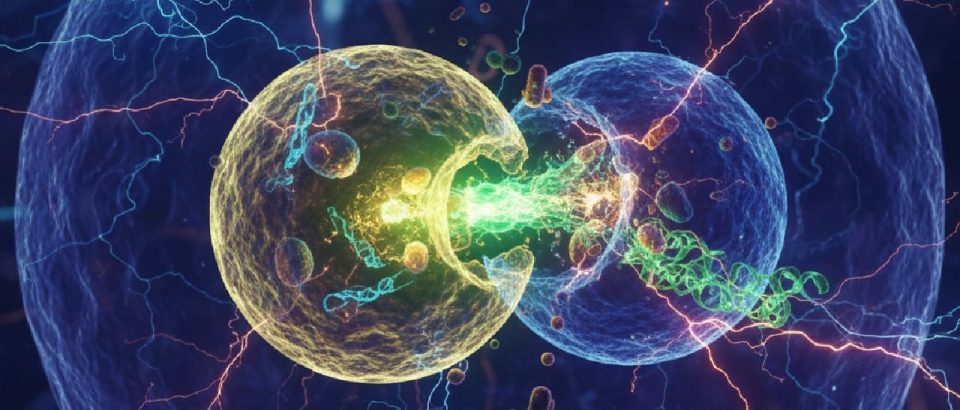
Your cells are electric batteries. Inside each cell, researchers have measured electric fields as strong as 15 million volts per meter—that’s five times stronger than a lightning bolt. The cell membrane itself generates an even more intense electric field and the healthy mitochondria membrane is approximately 30 million volts per meter.
So what does this mean? It means every cell in your body is essentially a battery, holding massive electrical potential across membranes that are only 5-10 nanometers thick.
When you fast, you’re not just “going without food.” You’re creating the conditions for this electrical system to clean the inflamation, recharge, for damaged cellular components to be cleared out, and for your body to shift from sluggish mode to repair mode and rejuvenation.
When you eat 70% of the energy available is consumed by the process of digestion.
In other words, fasting is about longevity first. Weight loss is just a side effect.
<h1 class='my-heading'>Just some HTML</h1><?php echo 'The year is ' . date('Y'); ?>
Why Fasting Works: The Science Your Body Already Knows
Let me take you inside what’s happening at the cellular level. When you stop eating for a period of time—even just 12 to 16 hours—your body initiates a process called autophagy. The word comes from Greek: “auto” meaning self, and “phagy” meaning eating. Special enzymes in our cells literally begin eating themselves. But in a good way.
Think of it like this: your cells are constantly producing waste. Damaged proteins, dysfunctional mitochondria, cellular debris. Normally, your body is so busy processing incoming food that it doesn’t have time to clean up. But when you fast, it’s like you’ve given your internal cleaning crew permission to finally do their job.
Autophagy begins ramping up between 16 and 24 hours of fasting, when your body starts clearing out old cells and proteins. By 24 to 48 hours, autophagy reaches deeper levels, with cells cleaning out damaged parts more thoroughly.
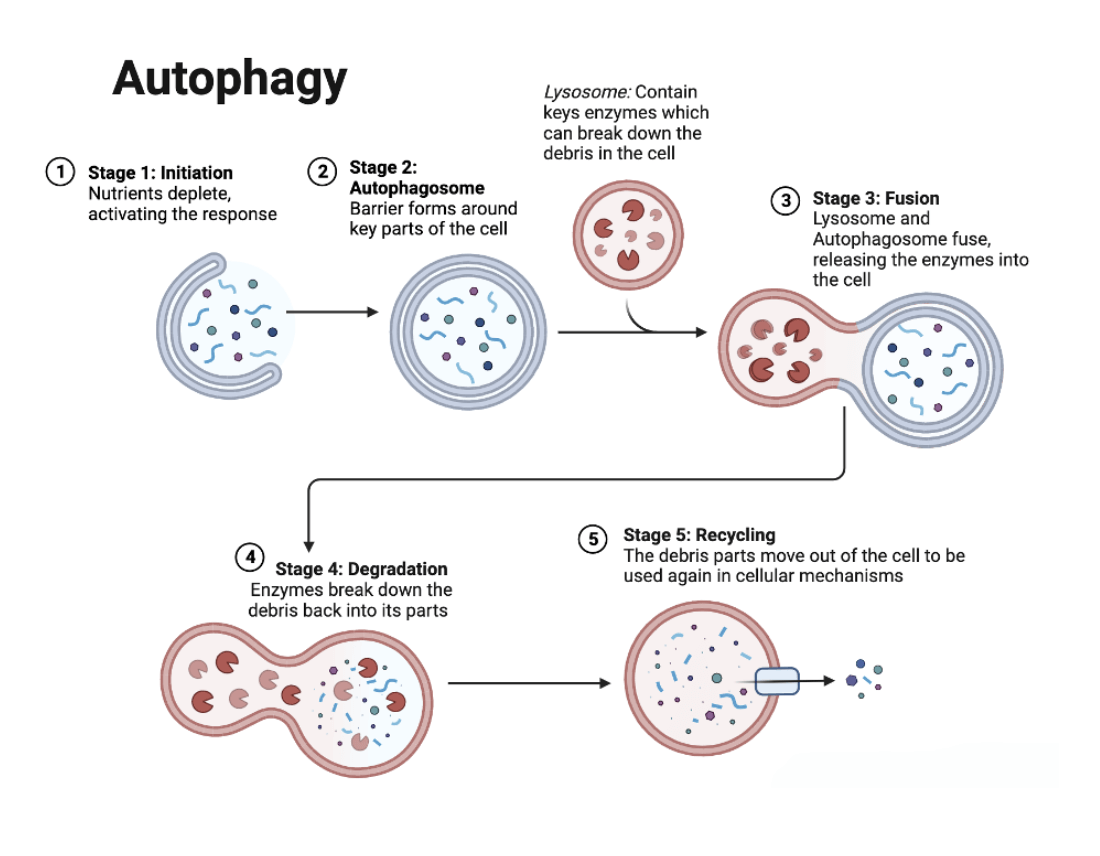
Here’s what Dr. Valter Longo, one of the pioneering researchers in fasting and longevity, has observed: Intermittent fasting and calorie restriction can lead to the induction of adaptive autophagy and increase longevity of eukaryotic cells. This isn’t theoretical. This is happening in your body right now if you’ve fasted for more than 16 hours.
But let me tell you what’s really interesting. Most people think they need to supplement their way to longevity. NAD+, NMN, resveratrol—the list goes on. And so while I’m not against supplements entirely, here’s what I want you to understand: your body has an innate intelligence. When you fast, you’re triggering natural cellular mechanisms that supplements are trying to mimic.
The Supplement Paradox: Why Less Is More During Fasting
Going back to what I said about autophagy. When you take supplements during your fasting window, you’re potentially interfering with the very signals your body is responding to. Your cells need to feel that nutrient stress to activate autophagy. It’s like trying to cook a frog but in a good way—you want the gradual, gentle pressure that tells your cells, “Hey, we need to clean up and optimize.”
What I’ve seen in my own practice is this: people who fast clean—just water, maybe some minerals—experience more dramatic cellular benefits than those who try to hack the process with supplements. Why? Because the fasting state is about clarity of signal. Every supplement you take is another conversation happening at the cellular level, and not all of those conversations support the autophagy process.
In other words, trust your body’s intelligence. The cellular cleanup mechanism has been refined over millions of years of evolution. It doesn’t need a supplement protocol to work. It needs time and space.
“I used to take a dozen supplements every morning during my fasting window, thinking I was optimizing. But when I stripped it back to just water and minerals, that’s when I finally felt the mental clarity everyone talks about. It was like my body could finally hear itself think.”
— Marcus, 52, Technology Executive
The Mindset Framework: Making Fasting a Lifestyle, Not Another Diet
So let’s talk about the most important part of fasting for longevity: the mental framework. Because here’s what happens to most people. They try fasting, feel terrible for a few days, and quit. Then they tell themselves, “Fasting isn’t for me.”
But that’s not true. What’s actually happening is they’re approaching fasting like a diet—something to white-knuckle through, something to survive. And so the body responds with stress signals: anxiety, fatigue, mood swings.
What I’ve developed over decades of working with high-performers is a simple tracking system that transforms fasting from a willpower battle into a data-informed practice. It’s called the 1-10 Scale Method.
The 1-10 Scale Method: Tracking What Matters
Every morning during your fasting period, you rate yourself on three scales:
1. Energy (1-10): How energized do you feel? Not wired from coffee, but genuine cellular energy.
2. Mental Clarity (1-10): Can you focus? Are you sharp in meetings?
3. Hunger (1-10): What’s your actual hunger level? Not habitual eating desire, but physical hunger.
What you’re doing here is building a feedback loop. You’re teaching yourself to recognize the difference between “I’m used to eating now” and “my body actually needs food.” That distinction is everything.

Going back to the idea of fasting as a lifestyle. When you track these numbers, you start to see patterns. Maybe your energy dips on day 3 but rebounds strongly by day 5. Maybe your mental clarity peaks between hours 16 and 20 of your fast. This is your body’s unique signature, and it’s telling you exactly when you’re in the optimal fasting zone for cellular repair.
Mindset Chunking: The 12-hour to 90-Day Framework
I don’t ask people to commit to “fasting forever.” That’s overwhelming. Instead, I use what I call mindset chunking. Mindset chunking is a cognitive strategy where you break down overwhelming information, tasks, or goals into smaller, manageable “chunks” or units to reduce cognitive load, improve memory, and make things feel less daunting, allowing for better focus and proactive action rather than just reacting to the whole.
Say you’re starting out and want to fast 16 hours daily. Its easier to commit two 8-hours chunks of fasting. Your mind can more easily believe that is possible. Then over time extend that to 18 or 20 hours of fasting daily for 90 days of consistent practice, tracking your 1-10 scales daily.
Here’s the framework:
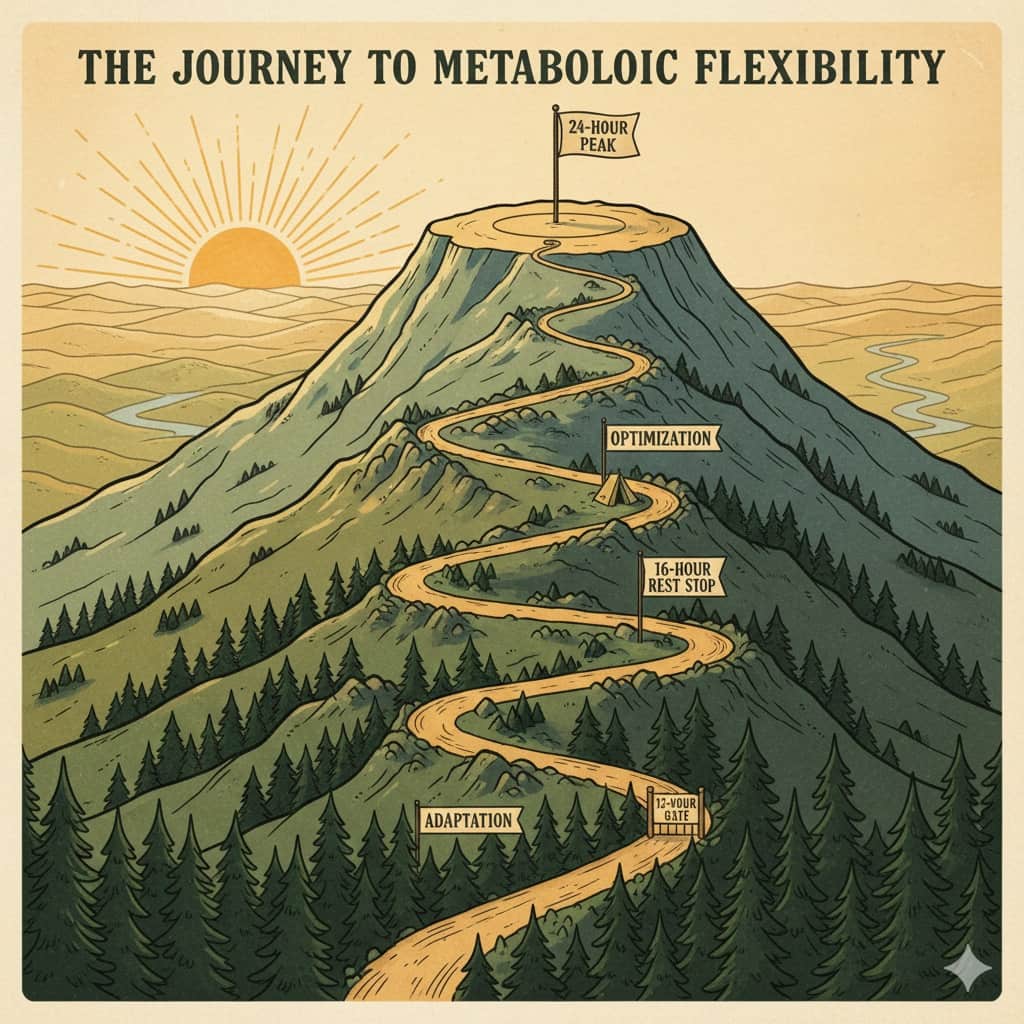
Days 1-30: Adaptation Phase. 16 hours daily chunked into two 8 hours “I can do that mindset”. Your body is learning. Expect some discomfort. This is normal. You’re metabolically inflexible right now, but that’s changing, fast!
Days 31-60: Optimization Phase. 18 hours daily chunked into two 9 hour commitments. Now you’re feeling it. Energy is stabilizing. Mental clarity is improving. You’re getting stuff done. You’re starting to understand your body’s rhythms.
Days 61-90: Integration Phase. 20+ hour fasts. Some days only OMAD. Fasting isn’t something you do anymore. It’s who you are. Your body has metabolic flexibility. You move in and out of fasted states with ease.
And so what happens at the end of 90 days? You don’t stop. You simply choose to continue because you feel better than you have in years. And you now are ready for 24, 48 or 72+ hour fasts. That’s the difference between a diet and a lifestyle.
“The “chunking” and 1-10 scales changed everything for me. I stopped trying to push through and started listening. By week 6, I knew exactly when my body wanted to fast and when it needed food. It’s not willpower anymore—it’s wisdom.”
— Jennifer, 47, Healthcare Administrator
When Fasting Feels Hard: What Your Nervous System Is Really Telling You
Let me tell you what nobody talks about. Some people struggle with fasting not because they’re weak-willed or because “fasting isn’t for them.” They struggle because their nervous system is dysregulated.
I’ve worked with thousands of clients over 40 years, and what I’ve discovered is this: if your autonomic nervous system is stuck in sympathetic overdrive—fight or flight—fasting will feel terrible. You’ll get anxiety, heart palpitations, crushing fatigue.
Why? Because fasting is a mild stressor. It’s supposed to be. That stress triggers autophagy, triggers cellular repair. But if your nervous system is already maxed out from chronic stress, work pressure, poor sleep, or past trauma, then fasting becomes the straw that breaks the camel’s back.
In other words, your body is telling you something important. It’s saying, “I need support before I can do this deeper work.”
The Missing Piece Most Fasting Protocols Ignore
What I’ve found is that supporting nervous system resilience before and during fasting makes all the difference. This is why some people sail through fasting while others suffer. It’s not about genetics or willpower. It’s about the state of your autonomic nervous system.
The techniques I teach—breath work, grounding practices, and yes, strategic use of electrotherapy devices like SCENAR—help calm the nervous system enough that fasting becomes sustainable. When your nervous system feels safe, your body can relax into the fasting state and access the cellular repair mechanisms.
“I tried fasting three times and failed every time. Panic attacks, couldn’t sleep, felt like I was dying. Then Benedick taught me about nervous system regulation. Once I addressed that first, fasting became almost easy. The benefits everyone talks about? I finally understand.”
— David, 58, Financial Services Executive
The Cellular Voltage Connection: Why Fasting Powers Your Bioelectric System
Here’s something that blows most people’s minds. Your cells run on electricity. Not metaphorically. Literally. Every living cell has a membrane potential of about -70mV, with the inside of the cell being negative relative to its external surface.
And so when we talk about cellular health, we’re really talking about electrical health. A healthy cell maintains proper voltage. A sick cell, a cancer cell, a dying cell—these all have compromised voltage.
What does this have to do with fasting? Everything.

The Science You Should Understand: The 30 Million Volt Reset
Your mitochondria—the power plants in every cell—operate in an electrical field on the order of 30 million volts per meter.
When that cellular voltage drops (from chronic stress, poor metabolic health, aging), everything gets harder: healing, thinking, moving, even feeling hopeful.
When you fast, you’re allowing your cells to optimize their electrical systems. You’re reducing the metabolic burden of constant digestion, which means more energy available for maintaining proper cellular voltage. Biologists using nano-scale voltmeters have measured electric field strengths as high as 15 million volts per meter within different regions of the cytoplasm.
Think about that. Inside each of your cells, there’s an electrical environment more powerful than a lightning bolt. And fasting helps maintain that power.
This is why I’ve dedicated so much of my work to understanding bioelectric medicine. The body is fundamentally electrical. Food, sleep, stress, fasting—all of these affect your cellular voltage. And cellular voltage affects everything: your energy, your immune function, your ability to repair damage, your longevity.
Bottom line: when you optimize your cellular voltage through practices like fasting, you’re addressing health at its most fundamental level.

The Supplement Paradox: Why Less Is More During Your Fasting Window
I want to come back to this because it’s so important. The supplement industry wants you to believe you need a dozen pills to make fasting work. NAD+ boosters, electrolytes, BCAAs, exogenous ketones—it never ends.
But here’s what’s really happening. Autophagy is induced when cells are stressed or deprived of nutrients, forcing them to repurpose cell components to function. When you introduce supplements, you’re changing that nutrient equation. You’re telling your cells, “Actually, we do have incoming nutrients,” which can dampen the autophagy signal.
Now, I’m not saying supplements have no place. After your eating window opens, strategic supplementation can support your overall health. But during the fast itself? The evidence suggests your body does better work when the signal is clean.
What I’ve seen in my practice: people who fast with just water and essential minerals (sodium, potassium, magnesium—not for nutrition but for electrolyte balance) report deeper benefits than those taking a full supplement stack during their fasting window.
What Your Body Actually Needs During a Fast
The truth is simpler than the supplement companies want you to believe:
Water: Obvious, but many people under-hydrate during fasts.
Minerals: Sodium, potassium, magnesium. Not for energy, but to maintain electrolyte balance. You can get these from quality salt or mineral supplements.
Time: The longer you give your body in a clean fasted state, the deeper the cellular cleanup.
That’s it. Your body has everything else it needs already stored in your tissues. Trust the process.
“I spent hundreds on fasting supplements. When I finally tried a clean fast—just water and minerals—the difference was night and day. My body knew exactly what to do. I just had to get out of the way.”
— Sarah, 44, Nonprofit Director
What’s interesting about all these stories? None of them are really about weight loss. They’re about vitality, about cognitive function, about reducing inflammation, about feeling decades younger. That’s what fasting for longevity means.
Your First 90 Days: A Practical Fasting Protocol for Busy Professionals
So you’re convinced. You want to start fasting for longevity. What now?
Let me give you the framework I use with executives and high-performers who don’t have time to waste on protocols that don’t work.
Week 1-2: The 12-Hour Foundation
Start simple. 14 hours. You finish dinner before sunset, say 6pm depending on the season. You don’t eat again until 8 -9 AM. That’s it. This isn’t even really fasting—it’s just not snacking before bed. But it starts building the habit.
Your only job: track your 1-10 scales every morning. Energy, mental clarity, hunger. Start learning your body’s language.
Week 3-4: Moving to 14-16 Hours
Now you push it a little. You finish dinner before sunset, say 6pm depending on the season. First meal at 10 AM. This is where you start feeling the metabolic shift. Around the 16-hour mark, your body begins breaking down old cellular components and proteins, crucial for cellular maintenance and metabolism.
Some days will be harder than others. That’s fine. You’re training metabolic flexibility.
Week 5-8: The 16:8 Sweet Spot
This is where most people land for daily practice. 16 hours fasting, 8-hour eating window. Keep it up for a month.
Between 16 and 24 hours, autophagy ramps up significantly, with your body clearing out old cells and proteins while ketones begin fueling the brain.
At this point, you should be noticing: better mental clarity, more stable energy, possibly some weight loss, better sleep, reduced inflammation.
Week 9-12: Experimenting with Extended Fasts
Once or twice a month, try a 24-hour fast. This is where the deeper cellular cleanup happens. At 24 hours, autophagy reaches peak levels, repairing cellular damage and reducing inflammation, with growth hormone levels surging.

Troubleshooting Common Obstacles
“I get terrible headaches.” — Usually electrolytes. Add quality salt to your water.
“I can’t sleep.” — You might be eating too late. Close your eating window before sunset.
“I feel anxious and shaky.” — Nervous system issue. Exercise, I go for a jog and take a cold shower.
“My energy crashes.” — Relax, it’s OK. You’re probably not fat-adapted yet. Give it more time.
What I’ve learned in 40 years: the body adapts. But you have to give it time and consistent practice. The 90-day framework works because it’s long enough for real metabolic adaptation but short enough to stay committed.
Conclusion: Fasting as a Longevity Practice
Going back to where we started. Fasting isn’t a diet. It’s not about restriction or suffering or fitting into smaller clothes.
What fasting really is: a way of allowing your body to do what it already knows how to do. Clean up damaged cells. Optimize electrical systems. Repair mitochondria. Clear out inflammatory proteins. Reset metabolic pathways.
The research is clear. Controlled calorie restriction or intermittent fasting can lead to lifespan-extending and antiaging effects through the activation of adaptive autophagy and adequate homeostasis.
But beyond the research, here’s what I know from four decades of practice: the people who approach fasting as a lifestyle rather than a diet are the ones who transform their healthspan. They’re the ones still hiking mountains at 70, running businesses at 65, sharp and energized at 80.
And so the question isn’t whether fasting works for longevity. The question is: are you ready to trust your body’s intelligence? Are you ready to step back from the constant supplementation, the bio-hacking anxiety, the search for the next magic pill, and simply allow your cells to do their work?
Your body already has 30 million volts per meter of electrical potential running through every cell membrane. It already has autophagy mechanisms refined over millions of years of evolution. It already knows how to repair, renew, and optimize.
Your job is just to get out of the way.
Frequently Asked Questions
Q1: Will fasting slow my metabolism?
No. This is a myth from outdated diet science. Short-term fasting (16-48 hours) actually increases metabolic rate slightly due to increased norepinephrine. Short-term and moderate calorie restriction practiced correctly in young and middle-aged individuals can be used with no prominent adverse effects. What slows metabolism is chronic calorie restriction combined with high stress—which is completely different from intermittent fasting.
Q2: How long do I need to fast to trigger autophagy?
Research suggests autophagy starts to ramp up around 18 hours of fasting and becomes more pronounced between 48 to 72 hours. But significant benefits begin even at 16 hours. The sweet spot for most people is 16-24 hours for regular practice, with occasional longer fasts for deeper cellular cleanup.
Q3: Can I exercise while fasting?
Work with your doctor. Fasting can affect medication absorption and blood sugar regulation. If you’re on blood pressure or diabetes medications especially, you need medical supervision as fasting often improves these conditions and your medication needs may change.
Q4: What if I'm already taking medications?
Work with your doctor. Fasting can affect medication absorption and blood sugar regulation. If you’re on blood pressure or diabetes medications especially, you need medical supervision as fasting often improves these conditions and your medication needs may change.
Q5: Is fasting safe for women?
Yes, with some considerations. Women’s hormonal cycles may require more flexibility in fasting protocols. Some women do better with shorter fasting windows (14-15 hours) or cycling their fasting practice around their menstrual cycle. The key is listening to your body’s signals.
Q6: What breaks a fast?
Anything with calories technically breaks a fast. But the autophagy question is more nuanced. Small amounts of fat (like MCT oil or butter in coffee) may not completely shut down autophagy, while protein and carbs definitely will. For maximum longevity benefits, stick to water, black coffee, and tea during your fasting window.
Q7:How is this different from just skipping breakfast?
Intent and consistency. Skipping breakfast randomly while still eating late-night snacks doesn’t create the metabolic conditions for autophagy. Strategic fasting with consistent timing and a compressed eating window does. It’s not about eating less—it’s about when you eat.
Q8: Will I lose muscle?
Not with proper protocol. During extended fasts, growth hormone levels surge up to 2000%, promoting fat burning and muscle building. The body preferentially burns fat for fuel during fasting while protecting lean tissue. Combine fasting with any exercise and muscle mass is maintained or even increased.
Ready to Go Deeper?
If you’re serious about using fasting as a longevity strategy, you don’t have to figure it out alone. The Ageless Warriors Alliance is a community of high-performing professionals, executives, and entrepreneurs who are committed to extending healthspan through integrated practices like strategic fasting, nervous system optimization, and bioelectric medicine.
Inside the Alliance, you’ll get:
- Personalized fasting protocols based on your nervous system profile
- Monthly bioelectric optimization sessions using cutting-edge approaches
- Community support from others walking the same path
- Direct access to my 40 years of clinical experience in longevity medicine
- Advanced training in cellular voltage optimization and metabolic flexibility
This isn’t about following a generic protocol. It’s about understanding your unique biology and optimizing it for maximum healthspan.
The Ageless Warriors Alliance is limited to serious practitioners only. We keep the group small to maintain high-touch support and deep community connection.
CLICK HERE and become a founding member of the Ageless Warriors Alliance →
Your cells are waiting. Let’s activate them together.
Sources and References
- Cleveland Clinic. (2022). “Autophagy: Definition, Process, Fasting & Signs.”
- International Journal of Biological Sciences. (2024). “Biological relevance of autophagy in cellular processes.”
- Levitas Clinic. (2024). “Basics of Cellular Renewal: The NoMAD Lifestyle Plan.”
- Liv Hospital. (2025). “How Many Hours of Fasting for Cell Repair? The Autophagy Timeline.”
- MIT Technology Review. (2007). “Lightning Bolts within Cells: Measuring intracellular electric fields.”
- National Center for Biotechnology Information. (2023). “The Beneficial and Adverse Effects of Autophagic Response to Caloric Restriction and Fasting.”
- Physiopedia. “Current Concepts in Electrotherapy: Membrane potential and cellular voltage.”
Benedick Howard has spent 40 years researching cellular health, bioelectric medicine, and longevity optimization. A former GE engineer turned consciousness pioneer, he combines cutting-edge science with ancient wisdom to help high-performers extend their healthspan.