The complete field guide to water fasting — the fuel switch, the autophagy and mitophagy timelines, the growth-hormone surge, and the transition that nearly killed me twice.
By Benedick Howard, Longevity Architect Last Updated: July 2026
Water fasting is going without food — water only — for a defined stretch, usually 24 to 96 hours or more. In that window your body walks a predictable road: it burns through stored sugar, flips to burning fat, ramps up cellular clean-up called autophagy, clears damaged mitochondria through mitophagy, and floods your system with growth hormone. That’s the real physiology. But the exact hour each stage “turns on” is far less precise than the apps and influencers promise — and the danger doesn’t live in the fast. It lives in the switch between fuels.
At 13,250 feet, in the full moon cold of a volcano night, my body stopped answering.
I had fasted the day before the climb and through it — the way I always did, because my sharpest, strongest hikes came on an empty stomach. But that night, in the bitterly cold cabin with the wind ripping though the cracks, and I ate a couple of “energy bars” and crashed, shivering unable to get warm. I was so glad to get going way before dawn, my feet numb and make the way down to the car. I hadn’t yet understood the thing this whole article is about: the difference between running on sugar and running on fat. My glycogen was not gone. My body was pulling cleanly from fat. I was ate the wrong fuel, the totally wrong way to refeed and end a fast. And my body was stuck in the gap between two fuels, at altitude, in a cold that does not forgive. It was a night from hell. Years later, in 2026, at home, I misread the same signal again and it nearly ended me a second time.
What Are the Main Benefits of Water Fasting?
Here are the five physiological shifts that happen during a water fast, backed by research:
- Water fasting moves through stages, not a stopwatch. Glycogen depletes, fat takes over, repair deepens — but timing varies by person, activity, and starting fuel load.
- The “metabolic switch” from sugar to fat typically happens 12–36 hours in — and hard exercise during a fast pulls it earlier.
- Autophagy and mitophagy — the cellular clean-up — and new mitochondria — are real, but their exact human timing depends on the amount of crap in your body. Most timing numbers come from animal studies.
- Growth hormone rises sharply during a fast: roughly 5-fold in young men and 4-fold in older adults over a two-day fast. It’s transient, and maybe nowhere near what the “2000%” hype claims.
- The refeed is the most dangerous part of the whole thing. Break a long fast wrong and you can land in the hospital. I break mine on a small salad, then vegetable soup.
Why Does the Intermittent Fasting You’ve Been Sold Keep Crashing You?
Your intermittent fasting crashes aren’t a character flaw — they’re a fuel problem. When you’re glucose-dependent and your blood sugar drops, your body screams for fast carbohydrates it’s addicted to. That’s metabolic inflexibility, and the mainstream ‘eat every three hours’ advice manufactures it.
I started fasting around 2017. Within a few months I settled into an 18/6 window — eating inside six hours, closing the kitchen before sunset, in rhythm with the light. I loved it. More energy, sharper focus, less sleep, up real early, more done before noon. My body felt like it finally ran on its own current.
But I still wrestled with the overeating demons. They were worst coming off my first two- and three-day water fasts, when I’d break the fast and my restraint would vanish. I broke down the exact mechanism of that crash in why your blood sugar crashes on intermittent fasting — start there if the afternoon collapse is your problem.
The fallacy is treating food as constant maintenance. Your body was built for the feast-and-famine cycle. Take the famine away entirely and you never learn to burn your own fat. That’s the real problem water fasting solves — if you understand the road.
What Actually Happens Hour by Hour? The Real Timeline
Your body moves through four distinct fuel stages during a water fast: glycogen depletion (0–18 hours), the metabolic switch to fat burning (12–36 hours), cellular clean-up called autophagy (24–48 hours), and a growth hormone surge that peaks around 48–72 hours. Here’s the research behind each stage — and why the exact timing varies more than the apps claim.
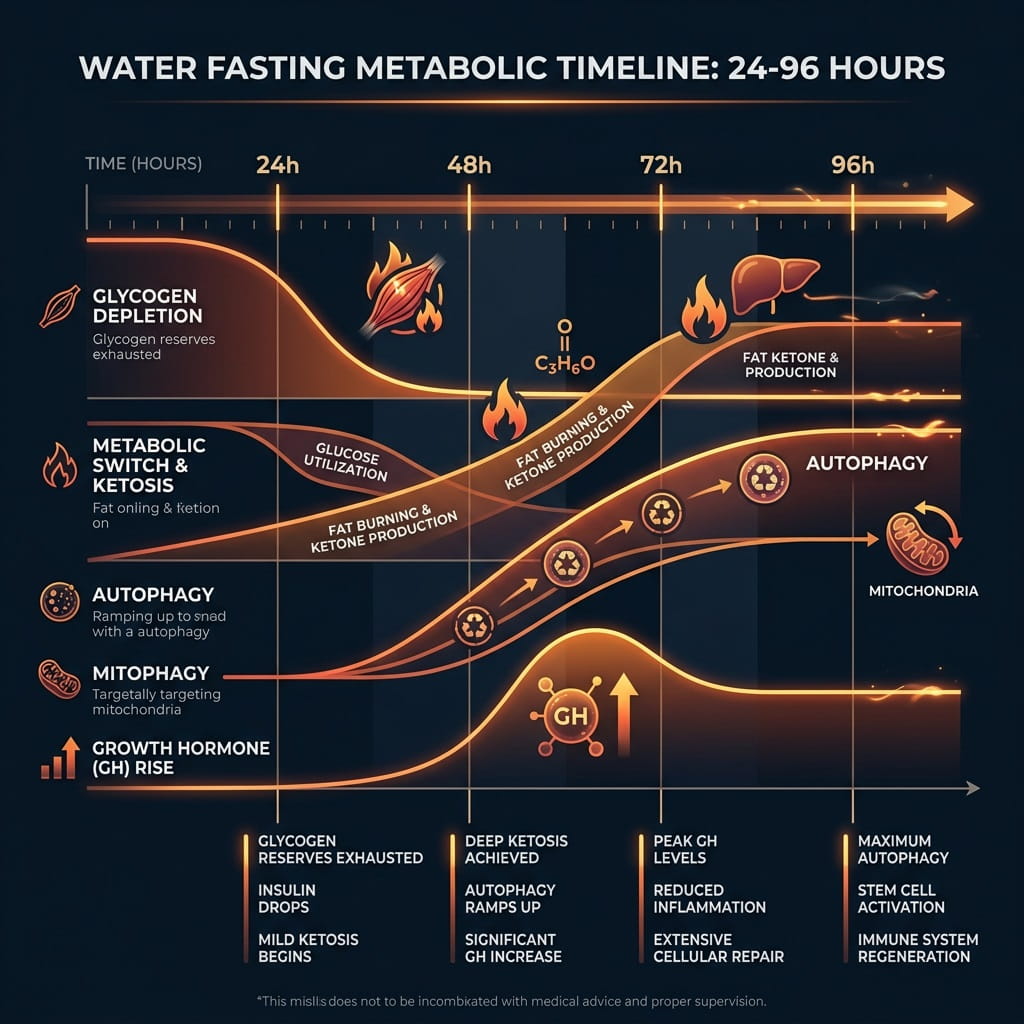
Hours 0–18: burning through the sugar. Your liver holds only about 100–120 grams of glycogen; your muscles hold more, but the liver’s store is what keeps your blood sugar up between meals. As it drains, insulin falls and glucagon rises. This is the familiar part — you do a gentler version of it every night while you sleep.
Hours 12–36: the metabolic switch. This is the hinge of the whole thing. In a 2018 review in Obesity, Stephen Anton and colleagues describe the “metabolic switch” as the point where liver glycogen is spent and the body mobilizes fatty acids and fat-derived ketones instead. They put it, on average, somewhere between 12 and 36 hours — and crucially, they note it depends on how much glycogen you started with and how much you move during the fast. Exercise drains the tank faster and flips the switch earlier. That single fact explains my volcano night: I’d exercised the switch forward into the coldest, most demanding hours, with no fat-adaptation to catch me.
Hours 24–48: autophagy — the clean-up. Autophagy is your cells eating their own damaged parts and recycling them. This is not fringe science — Japanese cell biologist Yoshinori Ohsumi won the 2016 Nobel Prize in Physiology or Medicine for uncovering the mechanisms of autophagy. The process is real, and it is fundamental. Here’s where I’ll be straight with you in a way the fasting apps won’t: the mechanism is Nobel-validated, but the timing in a living human is not. Most of the timing data comes from rodents, and autophagy is nearly impossible to measure in a person. autophagy markers rise noticeably around 24 hours and climb toward 48. In humans, one study of 21 volunteers found no significant autophagy markers in skeletal muscle even at 24 hours. A 2018 review of the literature concluded that fasting is one of the most potent natural triggers of autophagy across tissues — but “one of the most potent” is not the same as “your app knows the exact minute it switched on.” No blood test and no wearable can tell you autophagy is active right now. Anyone who claims otherwise is selling something.
What Does a 72-Hour Water Fast Do to Your Body?
Hours 24–72: mitophagy — clearing the dead mitochondria. Mitophagy is autophagy aimed specifically at your mitochondria — the little engines that make your energy. Damaged mitochondria leak and pollute; clearing them is how a cell stays young. Fasting sets the stage (insulin down, the energy sensor AMPK up, the growth signal mTOR down), and exercise drives the same AMPK pathway from the other direction. In 2017, researchers at the University of Virginia (Laker and colleagues, in Nature Communications) showed that exercise triggers mitophagy through AMPK signaling. And a 2013 study found higher autophagy in muscle when animals exercised in the fasted state versus fed. That is the mechanism behind something I’ve done on instinct for years: I always train during a fast. Fasting and movement stack on the same switch. The honest caveat, again: we can’t directly measure mitophagy in living human muscle, and it slows with age — which is exactly why it’s worth deliberately provoking after 45.
Hours 24–96+: the growth-hormone surge. This is the one the influencers inflate to absurdity. The real numbers are better than hype because they’re true. In a 1992 study from the University of Virginia, Mark Hartman and colleagues measured a roughly 5-fold increase in 24-hour growth-hormone output during a two-day fast in healthy young men. In 1996, the same group found a roughly 4-fold increase in older adults aged 55 to 81 — the age bracket most of you reading this are in. Growth hormone preserves muscle and bone while you burn fat. It’s transient, it doesn’t replicate a pharmacy’s GH injection, and it doesn’t need to. It’s your own physiology, switched on for free.
Why Do I Feel Weak During a Water Fast? (You’re Not Running Out of Energy)
You feel weak during a fast because you’re caught between two fuel tanks — not because you’re starving. Your small sugar tank is empty, but your vast fat tank hasn’t fully engaged yet. That gap is the ‘keto flu,’ and at altitude or in cold, it can be dangerous.
Biology is physics first. Strip away the poetry and a fast is an energy-systems problem.
You have two fuel tanks. One is sugar — small, fast, and the one the modern world keeps topped up so you never touch the other. The second is fat — vast, slow, clean-burning, and the one your body was designed to run on for days. Water fasting isn’t starvation. It’s the deliberate act of draining the first tank so the second one finally engages.
The mistake that nearly killed me twice wasn’t fasting. It was hitting the empty stretch between the tanks — glycogen gone, fat not yet flowing — while demanding maximum output in brutal cold. That gap has a name in the keto world: the “flu.” At sea level it makes you foggy and cold. At 13,250 feet it can make you a statistic.
The skill that closes the gap is metabolic flexibility — the trained ability to switch tanks without a crash. That’s not something you read about. It’s something you build, one fast at a time. It’s the “Voltage” pillar of the Triple-V framework made physical: a cell that can run on its own charge, from either fuel, on demand.
How Do You Safely Do a 3-Day Water Fast?
A safe 3-day water fast follows six steps: clear your environment of tempting food the week before, hydrate with intent, train through it to amplify growth hormone, and — most critically — refeed gently with a small salad first, then vegetable soup. Here’s the full protocol, scars included.
Every month I do a three-day water fast, now I’m testing a monthly 4 day fast. Not as punishment — as maintenance, the way you’d service an engine you intend to run for another forty years. Here’s the real protocol, scars included.
I prepare the week before. The single biggest predictor of whether I finish clean is what’s in the house. So the week prior, the tempting food goes. You cannot out-willpower a pantry full of sugar at hour 40. Remove the decision entirely, the days before I prepare my refeeding meals, salad, light carb poor snack, I’m burning ketones and need to switch slowly.
Can You Drink Coffee During a Water Fast?
I hydrate with intent. I hydrogenate my water most days, and drink coffee and Maca tea. On fasting days I give myself a treat — good bottled water, and the bubbly, mouth-cleansing bite of San Pellegrino is a favorite. It sounds small. At hour 30 it’s a lifeline that entertains the taste buds and keeps the fast enjoyable instead of grim.
I train through it. I exercise during the fast on purpose — to ride the growth-hormone surge and stack the mitophagy pathways I described above. Fasted movement isn’t a risk to manage; it’s the multiplier. (With one hard rule I learned the cold way: know where your fuel switch is before you push hard in a hostile environment.)
What Is Refeeding Syndrome and How Do I Avoid It?
And I respect the refeed above everything. This is the part that nearly ended me, and the part almost everyone underestimates. Coming off a multi-day fast, your body is not ready for a feast — break it wrong and you risk refeeding syndrome, a genuine, sometimes fatal electrolyte collapse. I break mine gently: a small salad first. Lately I’ve been making vegetable soups to come back on, and they taste so good it’s almost the best part of the fast. If you take one link from this article, take this one: how refeeding syndrome happens and how to break a fast safely before your first long one.
What Is the Best Water Fasting Protocol for Beginners?
Follow these seven steps for a safe, effective water fast, whether you’re doing 24 hours or 72:
- Clear the field first. In the days before, remove tempting food from your environment. Prep beats willpower every time.
- Ease in with time-restricted eating. Build to a fast through 16/8, then 18/6. A body already used to skipping meals switches tanks far more smoothly than one fed every three hours.
- Hydrate and mind your electrolytes. Water only — but the transition zone is where sodium, magnesium, and potassium matter most. This is the difference between a smooth switch and a crash.
- Move — but know your switch. Train during the fast to amplify growth hormone and mitochondrial clean-up. Just never push to your limit in cold or altitude while you’re in the fuel gap. That’s the mistake I’m still here to warn you about.
- Watch for the switch, don’t fear it. The wobble around 24–36 hours is your fuel changing tanks, not an emergency. Metabolic flexibility turns that cliff into a step. It builds with every fast.
- Refeed like it matters, because it does. Break gently: a small salad, then a real vegetable soup. Never a feast. If you’re fasting longer than 48 hours or take any medication, refeed under guidance.
- Repeat monthly. One long fast a month, done for maintenance, compounds. Metabolic flexibility is a trained capacity, not a one-time event.
Before you plan your next fast, you need to know your baseline:
The Longevity Assessment reads your energy charge across three systems — Voltage, Vibration, and Verticality — in about a minute, and shows you where fasting will move the needle most for your specific biology.
The Longevity Assessment — 14 Questions
Follow these seven steps for a safe, effective water fast, whether you’re doing 24 hours or 72:
Not a longevity score. A physics reading. Fourteen questions map your charge across three systems — Voltage, Vibration, Verticality — and show you where it’s building and where it’s leaking. Your Triple-V profile arrives instantly.
Your Triple-V Profile Is Ready
Enter your name and email. Your profile appears on screen instantly — and a copy, with your next move, lands in your inbox alongside the Sunday Briefings.
You’ll also receive the Sunday Briefings — field intelligence every Sunday, 2 PM HST. No spam. Unsubscribe any time.
Your Result
Book Your Bioelectric Assessment →This is a self-assessment for education, not medical advice, diagnosis, or treatment. It doesn’t diagnose or cure any condition and isn’t a substitute for your physician. Results reflect the inputs you gave.
Common Questions About Water Fasting
How long should a beginner water fast? Start with a single 24-hour fast, once, after you’re already comfortable skipping meals with 16/8 or 18/6. Twenty-four hours takes you through the metabolic switch safely. Only extend to 48 or 72 hours after several clean 24-hour fasts, and never jump straight to a multi-day fast cold.
When does autophagy actually start during a water fast? Honest answer: nobody can give you an exact hour. Animal studies show autophagy rising around 24 hours and climbing toward 48, but human timing is unconfirmed and can’t be measured by any app or wearable. Assume longer fasts do more, and ignore anyone claiming a precise “autophagy hour.”
Does water fasting really raise growth hormone? Yes, and it’s well documented. University of Virginia research measured roughly a 5-fold rise in growth hormone over a two-day fast in young men and about 4-fold in adults aged 55 to 81. It’s transient and preserves muscle while you burn fat — real physiology, not the inflated “2000%” figures online.
What’s the most dangerous part of water fasting? The refeed, not the fast. Breaking a multi-day fast with a large meal can trigger refeeding syndrome, a real and occasionally fatal electrolyte shift. Break gently — a small salad, then vegetable soup — and get medical guidance for fasts beyond 48 hours or if you take any medication.
Can I exercise while water fasting? Yes, and it amplifies the benefits — fasted movement drives the same AMPK pathway that clears damaged mitochondria, and it rides the growth-hormone surge. The one caution learned the hard way: don’t push to your limit in cold or at altitude while you’re in the fuel-transition gap, before your body is cleanly burning fat.
Is Water Fasting Worth It?
Yes — water fasting is worth it if you respect two things: the fuel transition gap and the refeed. The fast itself is safe. The danger lives in how you switch between fuels and how you come back. Respect those two, and fasting stops being an ordeal and becomes the reset your biology already knows how to run.
That night on the volcano, the cold wasn’t my enemy. My ignorance was. I didn’t understand that I was caught between two fuels, and the mountain nearly kept me for it.
You don’t have to learn it that way. Water fasting is one of the oldest, cleanest tools we have for taking your body back from a system that profits from keeping you fed, foggy, and dependent. It empties the sugar tank so the fat tank finally fires. It triggers the clean-up your cells have been waiting to run. It floods you with your own growth hormone, for free.
Just remember where the danger lives. Not in the going without. In the switch between fuels, and in the way you come back. Respect those two, and a fast stops being an ordeal and becomes what it was always meant to be: the reset your biology already knows how to run.
Drain the first tank. Trust the second. That’s the whole game.
What Should I Read Next About Fasting and Metabolic Health?
If water fasting resonated with you, these two articles go deeper on the mechanics and safety protocols:
- Why Your Blood Sugar Crashes on Intermittent Fasting — the exact mechanism behind the afternoon collapse, and why “eat every three hours” manufactures it.
- Refeeding Syndrome: How to Break a Fast Safely — the most important thing to read before your first multi-day fast. Non-negotiable.
About the Author
Benedick Howard is a Longevity Architect and former GE development engineer who left high-stress corporate life to study, in the field, how the body actually generates and holds energy. Off-grid on the Big Island of Hawaiʻi, he’s spent years testing strategic fasting, bioelectric therapy, and high-altitude training on the Hawaiian volcanoes — including the fasted climbs, and the two fuel-transition crises, described here. He is the author of the forthcoming High Attitude Hiking the Hawaiian Maunas and Fasting Is Faster.
Go forth, question everything. Do no harm, so love can blossom🌹 Many mahalos from Hawaii. Warrior out.