DENAS Vertebra 2 · 48 Electrodes · Shipped from the manufacturer

DENAS Vertebra 2: 48 electrodes that run your spine protocol without a therapist.

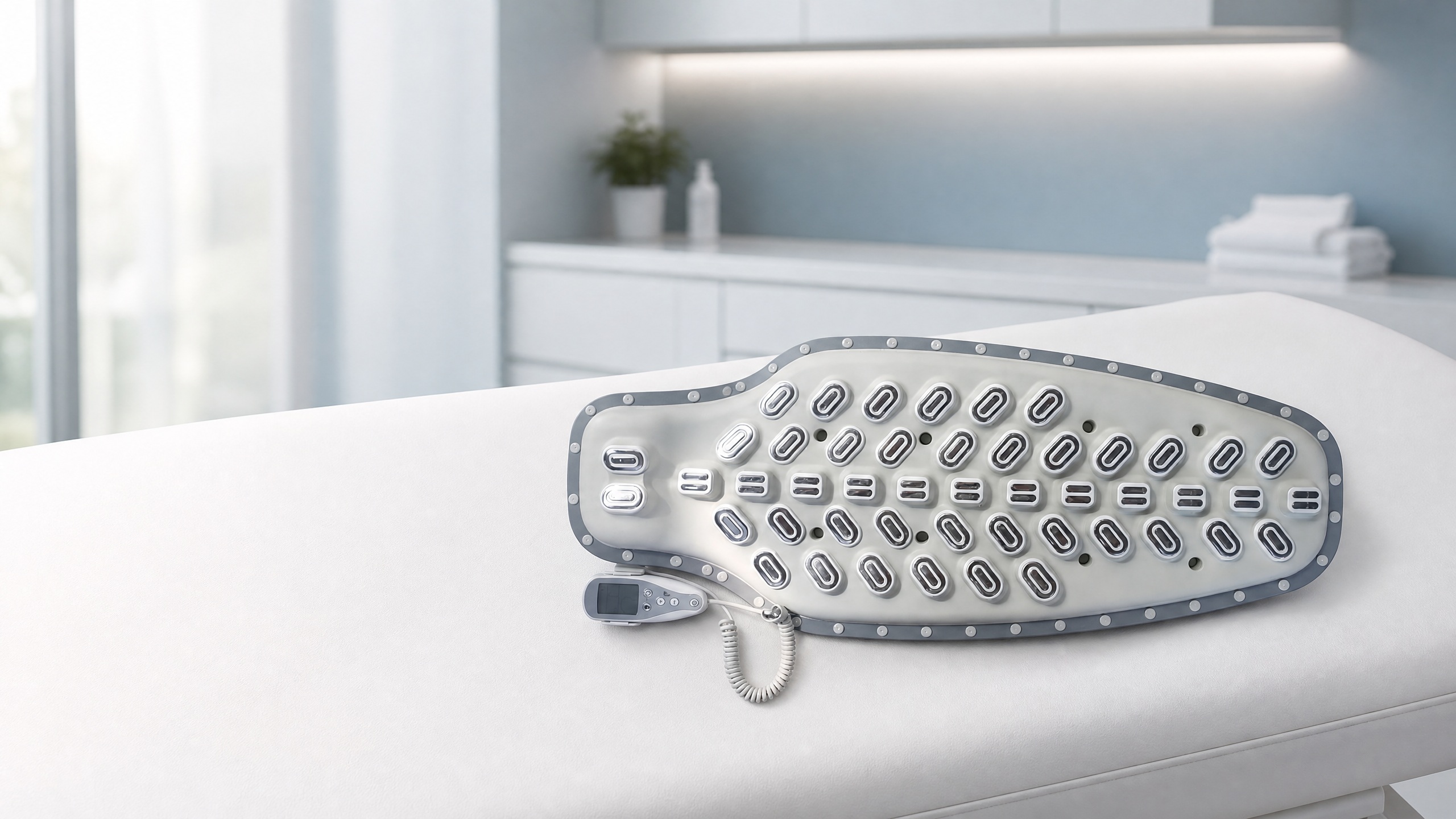
The DENAS Vertebra 2 is a 48-electrode microcurrent mat, built in Russia, for the whole back. You lie down, select one of five programs, and the controller sequences bipolar pulses through rows of electrodes running from the base of your neck to your sacrum. The device reads your skin impedance and adapts as the session runs. It automates the spinal work that classical Russian SCENAR protocols require a trained practitioner to perform by hand, one point at a time, for about forty five minutes. Benedick Howard, a former Canadian General Electric development engineer, has trained clinicians and device owners on Russian microcurrent equipment since 2002.

48
Electrodes
C7 to sacrum
5
Preset programs
20 to 200 Hz
10/35
Minutes per session
shortest to longest
0
People required
other than you

The mechanism

What the DENAS Vertebra 2 actually does

It charges tissue along the spine with low level electrical pulses, then reads how that tissue answers back and adjusts the next pulse accordingly. That feedback loop is the entire difference between a microcurrent device and a cheap muscle stimulator.

Your cells hold a charge, and it drains

Every cell in your body maintains a voltage difference across its membrane. Roughly 60 millivolts, held across a membrane a few nanometres thick. Run that arithmetic and the field strength inside you is enormous.

That charge is not decoration. It drives nutrient transport, waste clearance, and repair signalling. Injury pulls it down. Chronic load pulls it down. Thirty years at a desk under fluorescent light pulls it down.

A flat battery does not become a different battery. It becomes the same battery at a lower voltage. In my view that distinction is the whole argument, and it is the one the sick-care system has no billing code for.

Why 48 electrodes changes the arithmetic

A handheld microcurrent device has one electrode. One contact patch, moved by a trained hand, point by point, down one side of the spine and then the other. It works. I used that method almost exclusively in my practices in London and Hawaii after training to Master level with Professor Revenko. It also takes about forty five minutes and it takes somebody else.

The Vertebra 2 puts 48 electrodes under your entire back at once. The controller drives them in rows. You supply nothing but the decision to lie down.

Watch it

The explainer, in full

Everything above in one sitting. What the device is, how the array sits under the back, and what the controller is actually doing while you lie there.

DENAS Vertebra 2 explainer · hosted on Publitio

Five electrode rows · spine, paravertebrals, ribs

What a session feels like

The tingle moves

It travels. It does not sit in one spot and buzz, which is the whole of what a TENS pad does. Five rows of electrodes run the length of the spine and fire in sequence across three groups: the spine itself, the paravertebrals either side of it, and the outer rows out at the ribs.

Each of the five programs runs its own pattern, and no two are alike. The sequencing is considerably more involved than a specification sheet can convey, which is why the first session tends to land differently than people expect from reading about it.

You set the power yourself. Enough to feel it clearly, never enough to hurt.

Three pathway spinal assessment diagram used in classical Russian SCENAR training, showing the measurement points either side of the vertebral column

The three pathway assessment. Every point measured and dosed by hand.

The honest comparison

Why the classical protocol needed somebody else's hands

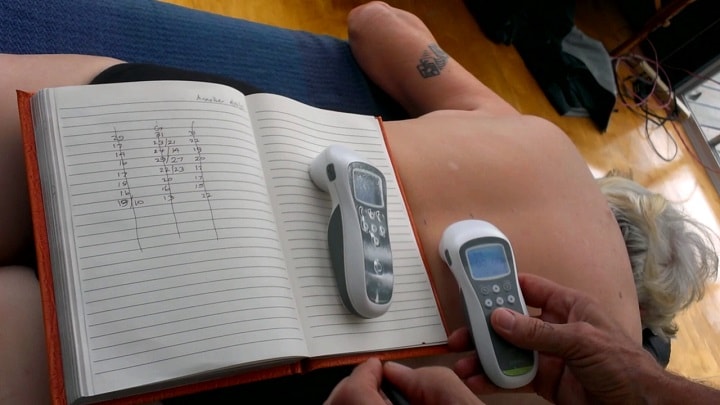
In a classical session you lie face down. The practitioner sets the power, you hear a beep and feel a tingle at C7, and the device works side to side down the spine to the sacrum. Low energy points get located and charged with what the Russians call a dose. Healthy tissue takes seconds. A first session takes considerably longer.

Over follow up sessions the practitioner maps the electrical readings at critical points. That map shows how the body is responding. It is genuinely skilled work and it is why the training exists.

What the Vertebra automates, and what it does not

It automates coverage. The whole back, every session, without a second person and without you contorting to reach your own lumbar spine.

It does not measure and dose individual points. It runs fixed frequency sequences across the full field. That is a different instrument doing a different job, and anyone who tells you it replaces a trained practitioner outright is selling rather than explaining.

If you want both, you buy both. Most owners who stay with this eventually do.

Specifications

The five programs, and when to run each

Every program is a defined frequency sequence over a defined duration. Nothing here is proprietary mystery. The numbers are printed in the manual and reproduced below so you can decide before you order rather than after.

DENAS Vertebra 2 program specifications
Program Frequency sequence Duration Typical use
A 60, 77, 140, 200, 20, 77 Hz 23 min The default. General spinal coverage and the longer neuropeptide response.
B 200, 77, 60, 77, 20 Hz 25 min Front loaded at the highest frequency. Used when discomfort is sharp and recent.
C 60, 77, 140, 20, 77 Hz 26 min General tonification. Mood and energy focused rather than site specific.
D 140, 77, 20 Hz 10 min The short one. A quick charge when time is the constraint.
E 60, 77, 140, 200, 20, 77, 10, 140, 77, 20 Hz up to 35 min Deep cycle. The full sweep, used for broad support and self assessment.

The device generates bipolar pulses, felt as gentle tingles, that adapt to changes in skin impedance while the session runs. Your skin is not the same conductor at minute twenty that it was at minute one. The device accounts for that. A TENS unit does not.

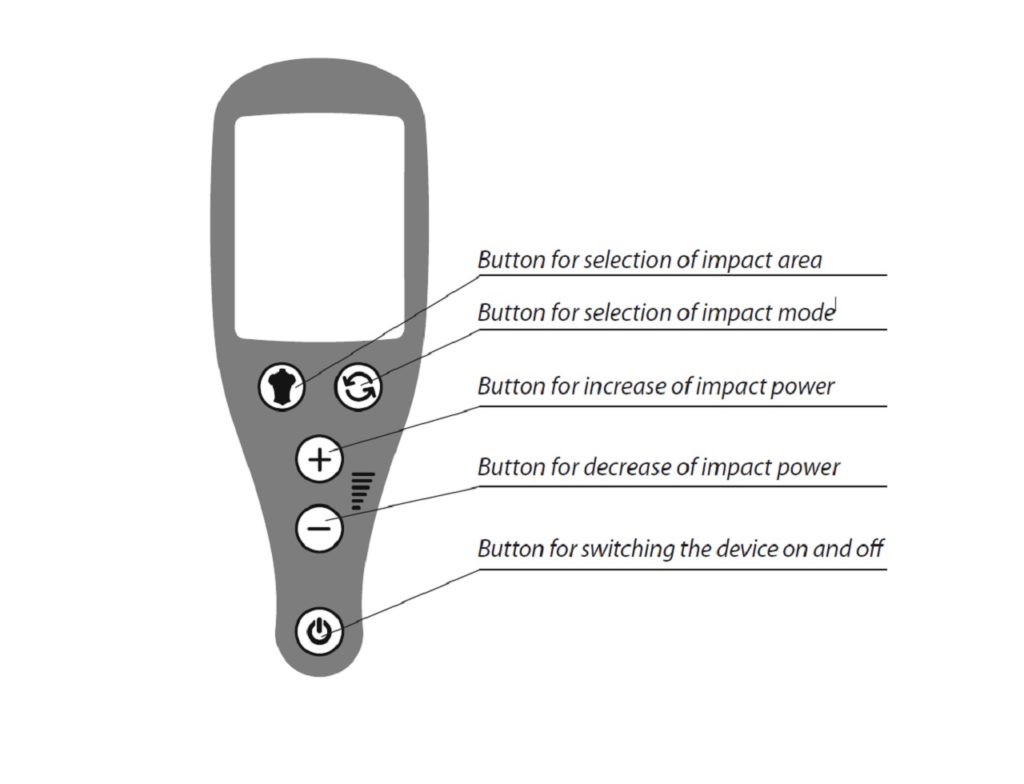
DENAS Vertebra 2 handheld controller showing the five program selection interface and power adjustment

The controller. Program select and power level, and that is the extent of the interface.

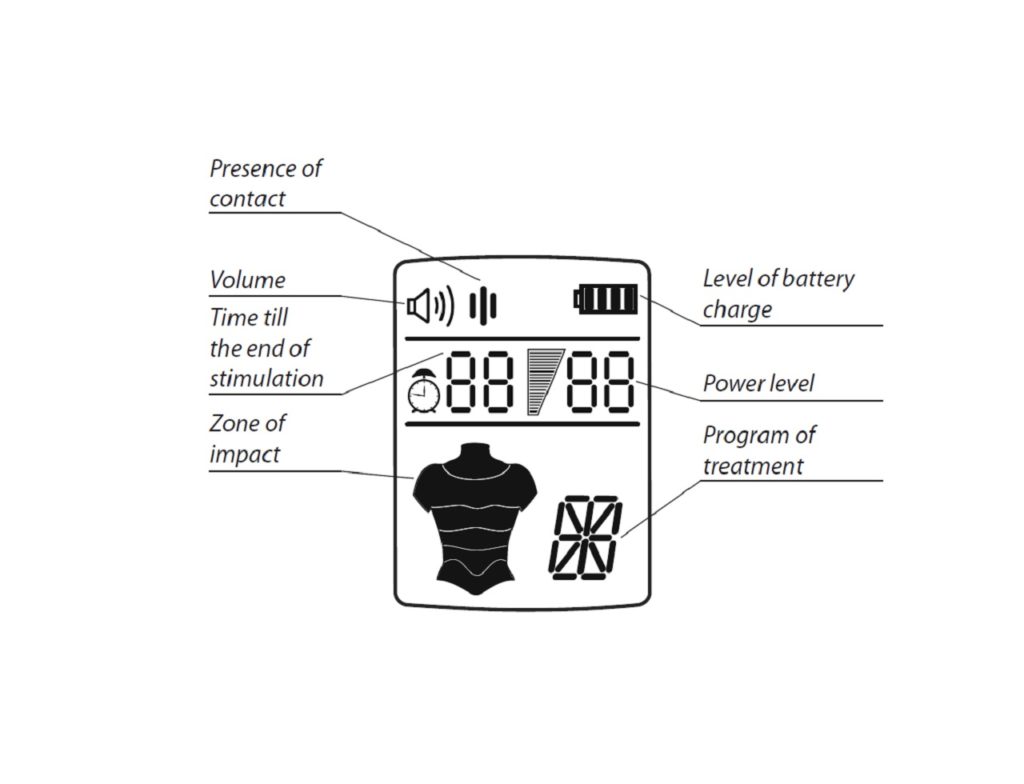
Close detail of the DENAS Vertebra 2 controller display showing program frequency and session timing readout

Frequency and timing readout during a running session.

Fit

Who the Vertebra 2 is built for

I would rather you self select out on this page than discover the mismatch after a non refundable order.

Profile 01

Founders and executives leaving the operating role

You spent thirty years treating your body as overhead. Now the operating role is ending and the body is the asset that decides whether the next chapter is expansive or narrow. You do not want a standing appointment with anyone. You want an instrument you control, in your own house, at five in the morning if that is when it suits.

Profile 02

Physicians, chiropractors and physical therapists

You have already read the mechanism and you can evaluate it faster than I can explain it. What you want to know is whether a preset device is worth bench space next to instruments you already trust. It earns that space when the back is the target and your own hands are the bottleneck. I have trained clinicians in your position since 2002.

Profile 03

Long term microcurrent owners

You already own a handheld unit. You already know what the tingle does. What you have never solved is applying it properly to your own back, because nobody can. This is the piece of the system you have been improvising around for years.

Who should not order this

Physical fit

Prominent spines and surgical hardware

The electrode array is a rigid moulding. Very bony backs and spines carrying surgical hardware from previous procedures may not achieve even contact. We solved positioning for most body shapes over several months of client work, but not for everyone, and I will tell you that before you order rather than after.

Expectation fit

Anyone wanting a device instead of a practice

A daily session of about thirty minutes is what produces anything worth having. Equipment bought without the intention to use it ends up on a shelf, exactly like the home gym in the spare room. That is not a hedge. It is the single most reliable predictor of whether this was money well spent.

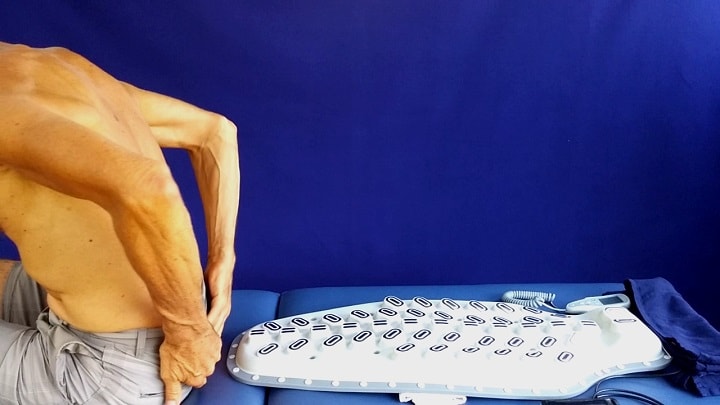
Correct body positioning on the DENAS Vertebra 2 electrode array, knees supported, spine aligned to the electrode rows

Positioning. The part the manual does not solve and the videos do.

What went wrong

My first session with it was a failure

When I was fourteen a block wall fell on my head. What followed was decades of neck, shoulder and lower back pain, dizzy spells, a locked neck and asthma. As a development engineer I could not accept the word incurable, so my own body became the test bench. That took three decades and a great deal of being wrong.

So when the Vertebra finally arrived from Russia I thought I knew what I was doing. I had studied the manual. I laid it out on my yoga mat, put a pillow under my knees, took my shirt off and lay down on it.

The electrodes were cold. They pushed into the bony parts of my spine. It felt like a yogi's bed of nails and I nearly wrote the whole thing off.

I ran the ten minute program anyway. When I got up afterwards I sat downstairs feeling thoroughly disillusioned about the device, and simultaneously aware that I was listening to the birds outside with a clarity I had not had that morning. The places on my spine that had hurt from the electrodes had stopped hurting.

It took months of work with clients before we had positioning solved for most body shapes. That work is now the setup training, and it is the reason I sell this with the training attached rather than as a box on its own.

I am 75. I hike the Hawaiian volcanoes and practise Ashtanga. The back that a wall broke when I was fourteen is not the thing limiting me now.

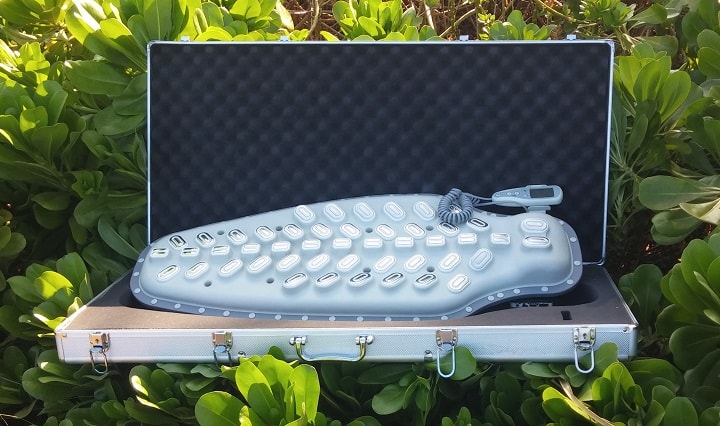
DENAS Vertebra 2 hard shell carry case as shipped from the manufacturer, opened to show the electrode array inside

It ships in a fitted hard case, not a cardboard box.

The order

What arrives, and what you get access to

The hardware. The Vertebra 2 electrode array, the controller, USB power, and a fitted carry case. Shipped from the manufacturer.

The setup training. The recorded module set covering orientation, the three part positioning sequence, the expanded manual walkthrough, and the self assessment scales. This is the part that stops the device becoming shelf furniture.

Access while you wait. The manual and the expanded video walkthrough open immediately, so the transit window is spent learning rather than waiting.

Owners

What Vertebra owners say

Only Vertebra owners appear here. Comments about the handheld devices belong on the handheld pages, and moving them across would be the kind of small dishonesty that eventually costs more than it earns.

On camera

Vertebra 2 owner interview

Vertebra 2 owner interview

Vertebra 2 owner interview

In writing

I do a lot of gardening and have been using hand held microcurrent devices for many years. Never have I got so much result in so little time as with the Vertebra 2 and use it at the end of the day to relax me like a massage.
Linde Farmer
Vertebra 2 owner · long term microcurrent user
Amazing. With years of chronic back problems I have tried everything. Now, thanks to the Vertebra 2 I have been pain free for weeks at a time.
Brandon
Vertebra 2 owner
The Vertebra is like owning your own masseuse.
Diane Monteil
Vertebra 2 owner

These are individual experiences described in each owner's own words. They are not a prediction of your result and they are not clinical data.

The evidence

What I will not claim about this device

There is a percentage that circulates on microcurrent pages across the internet, including on older pages of my own. It appears as 88.5. Elsewhere it appears as 88.25, as 82.5, as 80.25, as 90.4, as 91.7. Same 1980s Russian trials. Different decimal point depending on which page you happen to land on.

I am not going to hand you a number I cannot stand behind, and I am removing it from my own properties as I find it. If a figure cannot survive being checked, it should not be doing sales work.

What actually exists

The 1980s Russian clinical reports exist. They describe a treatment complex assessed across large patient groups by practitioners at varying levels of experience. They are not randomised controlled trials as a regulator would define one today, and anyone presenting them as such is overstating the case.

I keep the summary archive online so you can read it and reach your own conclusion rather than take mine. Read the 1980s SCENAR clinical studies summary.

What I will say

The device does what the specifications say it does. Forty eight electrodes, five frequency sequences, bipolar pulses that adapt to skin impedance. Those are engineering facts and they are checkable against the manual.

Everything beyond that is my professional read after applying this technology since 2002, and I will label it as exactly that rather than dress it up as a clinical finding. This device is not a treatment for any medical condition, it is not a substitute for your physician, and results differ from person to person.

If the missing percentage costs me the sale, so be it. I would rather lose the order than inherit somebody else's decimal point.

Before you order

Questions worth asking

  • How long does DENAS Vertebra 2 delivery take?

    Historically the unit shipped direct from the manufacturer in 10 to 15 working days, with a tracking number issued after about 5 days. Shipping routes out of Russia have changed considerably since that figure was set, so confirm current transit times before you order.

  • Do I need a handheld device as well?

    They do different jobs. The Vertebra covers the back you cannot reach yourself. A handheld device reaches everything else and travels with you. Most serious owners end up with both, but the Vertebra stands on its own if the back is what is limiting you.

  • Will it work if I have surgical hardware in my spine?

    The array is a rigid moulding, so hardware and very prominent vertebrae can prevent even contact regardless of positioning. Ask your physician about the electrical question and book a call with me about the mechanical fit question. Do not order first and ask second on a non refundable item.

  • Do I need training to use it?

    You need setup guidance more than protocol training. The programs are preset, so there is nothing to design. What is not obvious is how to position a particular body against a rigid electrode array so the contact is even, and that is exactly the thing that sends untrained units to the shelf. The setup modules come with the order.

  • What is the difference between SCENAR and DENAS?

    Both descend from the same 1970s work by Dr Alexandr Karasev and Dr Alexander Revenko in Taganrog, later refined with Russian doctors and scientists at Sochi. SCENAR and DENAS are different manufacturers of closely related technology. In practical application the differences are smaller than the marketing on either side suggests.

  • Is there a warranty, and can I return it?

    The manufacturer has offered a limited two year warranty against defects in material or workmanship, voided by misuse. Repairs have historically required return to the manufacturer with a long turnaround. The order itself is non refundable with no returns or exchanges. If that term gives you pause, book a call before you buy rather than after.

The order

Lie down. Let the charge do the work.

$2,497
Includes the Vertebra 2, the setup training modules, and shipping

Non refundable · no returns or exchanges · two year limited manufacturer warranty
If the fit is uncertain, book the call. That is what it is there for.

The DENAS Vertebra 2 is not offered for the diagnosis, treatment, cure or prevention of any medical condition. Nothing on this page is medical advice and nothing on this page substitutes for your own physician. If you have a diagnosed condition, an implanted electronic device, or any question about whether electrical stimulation is appropriate for you, ask your physician before ordering.

Benedick Howard is a coach and educator, not a licensed medical practitioner. Owner comments on this page describe individual experiences and are not a prediction of your result. Outcomes depend on consistent self application and on factors outside anyone's control. The average buyer of any coaching product may see no result at all, in the same way that the average buyer of home exercise equipment does not come to resemble the photograph on the box.

DENAS Vertebra 2
48 electrodes · 5 programs
Order