Executive Summary
Your heart is not a pump. It is a hydraulic ram and vortex generator that guides blood already in motion, driven by electrical charge — not mechanical pressure. This reframing, backed by research from Rudolf Steiner’s 1920 lectures to Dr. Branko Fürst’s 2023 peer-reviewed review in Experimental Physiology, shifts cardiovascular care from mechanical intervention to electrical conductivity and rhythmic coherence.
Where Did the Idea That the Heart Is a Pump Come From?
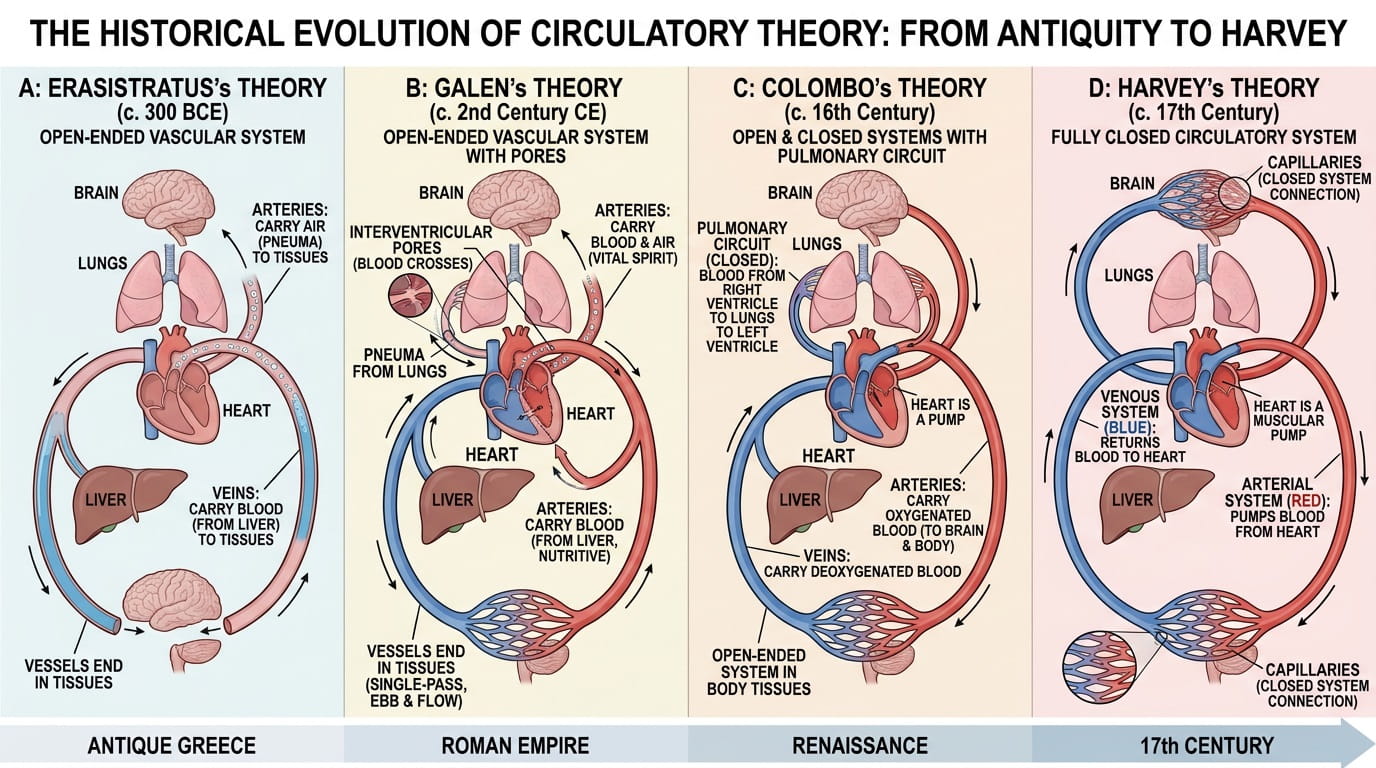
The heart-as-pump idea originated with William Harvey’s De Motu Cordis in 1628, when he described the heart as ‘the propulsive force behind the circulation.’ Harvey famously likened arterial ejection to blood forced “as if by a syringe,” establishing a mechanical paradigm that subsequent researchers rushed to quantify.
Quantifying the Mechanical Heart
- Giovanni Borelli calculated the heart’s motive force as equivalent to supporting 3,000 pounds, cementing the piston-pump analogy.
- Stephen Hales measured hydrostatic pressure directly by inserting glass tubes into arteries, watching blood rise over eight feet.
- Jean-Léonard-Marie Poiseuille derived the fundamental mathematical law governing fluid dynamics and vascular resistance.
- Alfred Volkmann invented precision instruments—like the hemadromometer and kymograph—to trace pressure curves.
By the mid-1800s, this instrumental framework made the pump model dominant. While dissenting vitalist ideas lingered in philosophy, mainstream science saw little documented refutation, embedding the concept so deeply that questioning it today feels like questioning gravity.
But gravity, at least, obeys the laws of physics.
Why Can’t a 300-Gram Heart Pump Blood Through 60,000 Miles of Vessels?
Here is the inconvenient math: your heart weighs roughly 300 grams. It is supposed to “pump” approximately 8,000 liters of blood per day through a vascular network that, if laid end-to-end, would circle the earth more than twice. Much of that journey happens through capillaries so narrow that red blood cells must fold and squeeze through single-file. The work required is equivalent to lifting 100 pounds one mile high. Every day. For decades. Without fatigue.
A conventional pump of that size and material would burn out within hours. Yet the heart beats roughly 100,000 times daily for 70, 80, 90 years. If it were truly generating all that pressure mechanically, it would be the most efficient machine ever built—by orders of magnitude.
Something else is going on.
What the Heart Actually Is: Hydraulic Ram and Vortex Generator
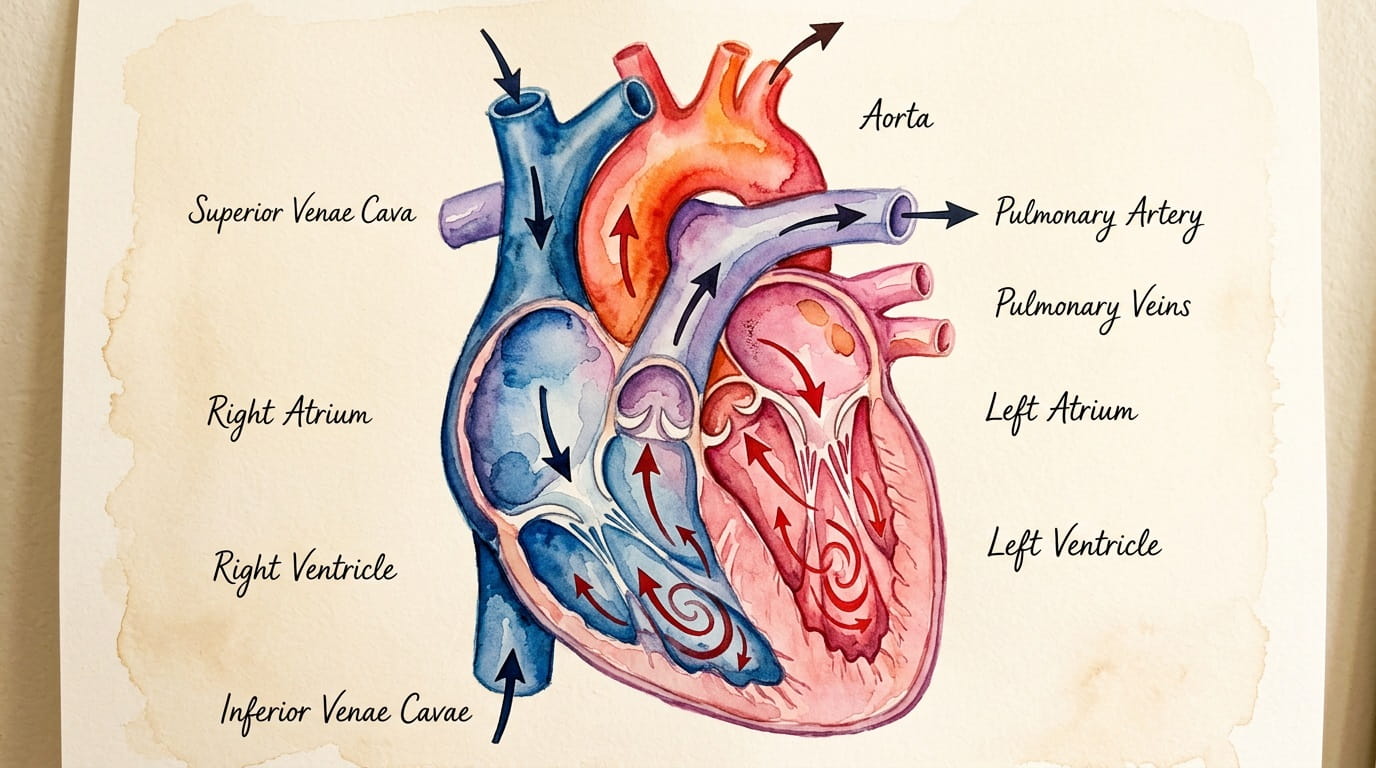
In 1920, Rudolf Steiner—founder of anthroposophical medicine—articulated a radically different view: the heart is not a pressure pump but a hydraulic ram. A hydraulic ram does not create flow; it interrupts and redirects flow that is already in motion. It dams, it holds back, it converts linear momentum into a vortex. The fluid enters with kinetic energy, the ram briefly arrests it, and the resulting pressure wave propels it forward.
What Is a Hydraulic Ram and How Does the Heart Work Like One?
This is not a fringe metaphor. In 1937, Hans Havlicek published the first peer-reviewed scientific paper explicitly comparing the heart to a hydraulic ram, pointing to both mechanical and morphological analogies. Cardiac surgeon Leon Manteuffel-Szoege spent decades studying embryonic circulation and deep hypothermic arrest, concluding that blood possesses its own kinetic energy derived from tissue thermal conditions. He wrote: “A pump sucks in fluid from a reservoir. In the circulation, not only is the blood ejected from the heart, but it flows into the heart. The heart is a mechanism inserted in the blood circuit, and so it is a very peculiar kind of pump.”
In other words, the heart receives blood that is already moving, shapes it into a vortex, and sends it on its way. It is an organ of rhythm and geometry, not brute force.
What Evidence Shows the Heart Doesn’t Pump Blood?
In 1932, J.L. Bremer at Harvard filmed blood circulating in very early chick embryos. The footage is remarkable: blood moves in self-propelled, spiraling streams before the heart is functional. The heart tube forms, but blood is already circulating. The embryonic heart does not initiate circulation; it joins circulation already in progress.
Bremer was so captivated by the spiraling nature of the flow that, according to later researchers, he “failed to realize that the phenomena before him had demolished the pressure-propulsion principle.” The blood was not being pushed. It was moving itself.
This observation was not an anomaly. In adult circulation, blood comes to a complete standstill in the capillaries to allow gas and nutrient exchange. It oscillates slightly, then resumes flow. If the heart were a distant mechanical pump generating pressure, restarting flow against gravity in vessels narrower than a human hair would be physically impossible. Yet it happens, billions of times per day, without the heart “knowing” what each capillary needs.
What Is Zeta Potential and How Does It Move Blood Without a Pump?
So if the heart is not the engine, what is?
Can You Improve Your Zeta Potential Naturally?
The answer lies in the electrical charge of your blood and vessels. Your blood vessel walls are hydrophilic—water-loving—and carry a negative surface charge. The water dissolved in your blood carries a positive charge. The repulsion between these opposite charges creates a natural electrokinetic force that moves blood through the vessels. This is called the zeta potential.
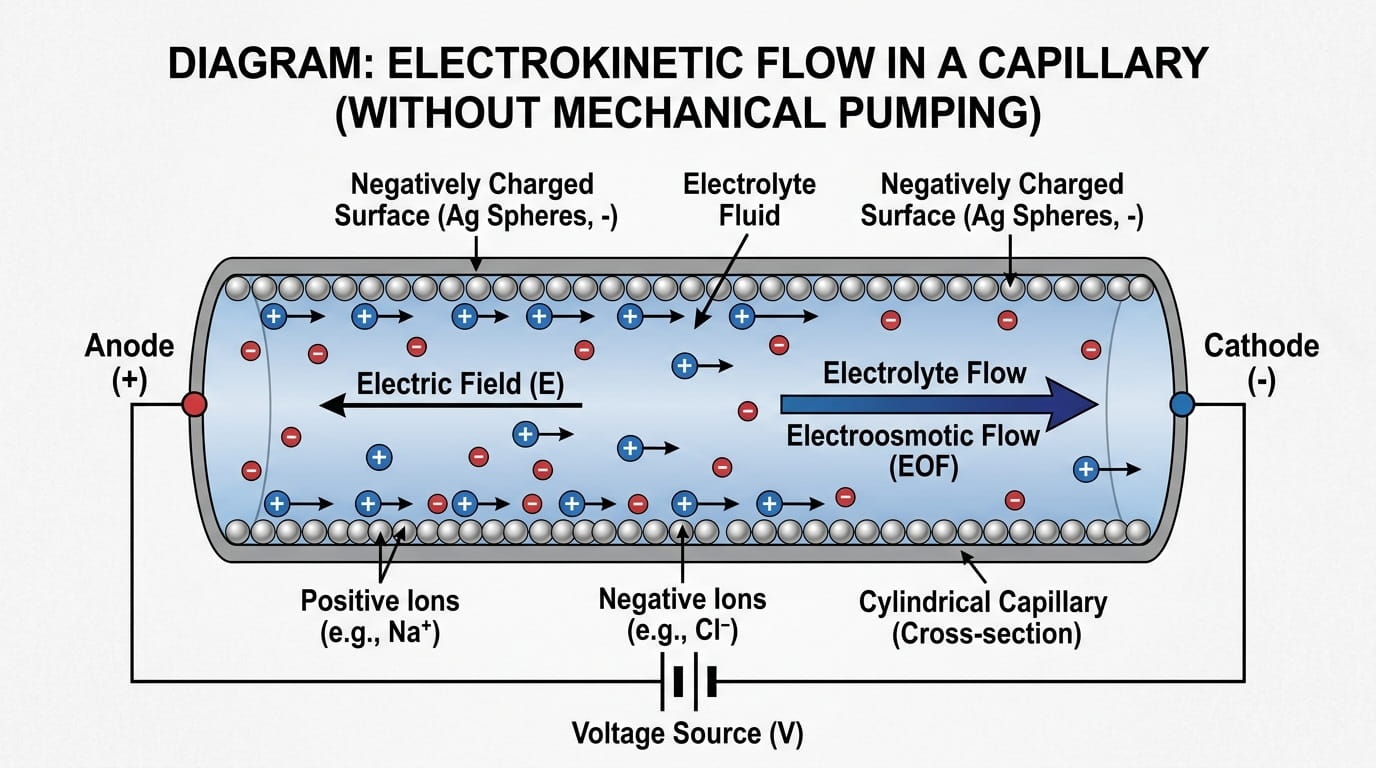
It is the same principle that allows a tree to draw water 300 feet up a trunk without a pump. The xylem tubes carry a negative charge; the water carries a positive charge. The resulting electrical gradient pulls water upward against gravity. Your circulatory system operates on the same physics.
Dr. Tom Cowan, in Human Heart, Cosmic Heart (2016), explains it this way: “Our blood vessels are hydrophilic tubes with a gel layer on the surface that carries a negative charge. Positively charged water in the blood is dissolved into the middle of the tube. The repulsion between the two charges starts the flow moving.”
The heart does not push blood uphill. The blood is already climbing, electrically.
How Strong Is the Heart’s Electromagnetic Field and What Does It Do?
If the heart is not primarily a mechanical pump, what is its deeper role? It is an organ of rhythm, resonance, and electromagnetic communication.
The heart generates the largest electromagnetic field in the body—roughly 40 to 60 times stronger than the brain’s. This field extends several feet beyond the body and can be measured with sensitive magnetometers. Every cell in your body is bathed in this field. The heart is not merely moving fluid; it is conducting an orchestra.
Dr. Cowan describes the heart as “a sensitive integrator of all our experience.” It listens to the blood, senses its chemical and energetic contents, and calls forth hormones to maintain homeostasis. When we treat the heart as a piston, we reduce it to plumbing. When we treat it as a vortex and electromagnetic conductor, we recognize it as the body’s primary rhythmic coordinator.
For the high-achieving professional—someone whose nervous system has been hijacked by deadlines, cortisol, and screen glare—this reframing is not abstract. It is practical. Your cardiovascular health is not about building a stronger pump. It is about maintaining the electrical conductivity, fluid coherence, and rhythmic integrity of your entire system.
How Should I Change My Approach to Heart Health If the Heart Isn’t a Pump?
If circulation is electrical and rhythmic rather than purely mechanical, then our approach to heart health must shift. The standard playbook—statins, beta-blockers, stents, and bypasses—treats the heart as a failing machine. But what if the problem is not mechanical failure but electrical degradation?
Here is what the hydraulic-ram model suggests for longevity:
1. Protect your zeta potential. Hydration is not just about water volume; it is about water structure and mineral balance. Structured water, adequate electrolytes, and reduced consumption of processed foods that disrupt charge balance all support the electrical gradient that moves your blood.
2. Prioritize rhythm over intensity. The heart is an organ of tempo, not torque. Chronic stress creates arrhythmic, incoherent heart-rate variability. Practices that restore rhythmic coherence—breathwork, meditation, time in nature, adequate sleep—are not luxuries. They are cardiovascular interventions.
3. Think conductivity, not pressure. Your blood vessels are not pipes. They are electrically active interfaces. Endothelial health, nitric oxide production, and the negative surface charge of vessel walls are what keep blood moving. Anti-inflammatory nutrition, movement, and grounding practices support this conductivity.
4. Verticality matters. In my 3V Protocol—Voltage, Vibration, Verticality—the “Verticality” component is not metaphorical. Gravity, posture, and spinal alignment affect how blood moves through the body. The heart-as-hydraulic-ram model depends on the kinetic energy of blood already in motion, and that motion is shaped by how we hold ourselves in space.
Who Discovered That the Heart Is Not a Pump?
This perspective has a documented intellectual history, even if it remains outside the medical mainstream:
- Rudolf Steiner (1920): First articulated the heart as hydraulic ram in anthroposophical medicine lectures.
- J.L. Bremer (1932): Filmed self-propelled, spiraling blood flow in embryos before heart function.
- Hans Havlicek (1937): Published the first peer-reviewed paper arguing the heart works as a hydraulic ram.
- Leon Manteuffel-Szoege (1960s–1980s): Cardiac surgeon; studied embryonic circulation and hypothermic arrest; concluded blood has its own kinetic energy.
- Ralph Marinelli et al. (1995): Synthesized Steiner, Bremer, and embryology into “The Heart Is Not a Pump: A Refutation of the Pressure Propulsion Premise,” published in Frontier Perspectives.
- Branko Fürst (2014–2023): Published The Heart and Circulation: An Integrative Model and, with José González-Alonso, a 2023 review in Experimental Physiology proposing a dynamic equilibrium between arterial and venous forces.
- Dr. Tom Cowan (2016–present): Modern synthesizer and popularizer; connects hydraulic-ram theory to zeta potential, embryology, and the heart’s electromagnetic field.
This is not a conspiracy of cranks. It is a coherent, century-long research thread that mainstream cardiology has largely ignored.
Common Questions About the Heart Not Being a Pump
Q1: If the heart isn’t a pump, why does it stop beating when someone has a heart attack? The heart is still essential to life. In the hydraulic-ram model, the heart maintains rhythm, creates vortices, and coordinates the electromagnetic field of the body. When it stops, circulation degrades because the rhythmic conductor has gone silent—not because the “engine” has stalled. The heart is necessary; it just isn’t doing what we were taught.
Q2: Doesn’t William Harvey’s work prove the heart is a pump? Harvey proved that blood circulates in a closed loop, which was revolutionary. But he did not prove how the heart accomplishes this. The pump interpretation was an assumption that Borelli, Hales, Poiseuille, and Volkmann later reinforced with mechanical analogies and instrumentation. Harvey discovered circulation; the pump model was an inference.
Q3: What is zeta potential in simple terms? Zeta potential is the electrical charge difference between the surface of your blood vessel walls (negative) and the water and ions in your blood (positive). This charge repulsion pushes blood through vessels without mechanical pressure, similar to how two magnets with the same pole repel each other.
Q4: Is there peer-reviewed science supporting this view? Yes, though it is a minority position. Branko Fürst’s 2023 review in Experimental Physiology and his 2014 book are peer-reviewed. Marinelli et al.’s 1995 paper was published by Temple University’s Center for Frontier Sciences. The broader challenge is that mainstream physiology journals rarely publish work that questions the pressure-propulsion paradigm.
Q5: How does this change what I should do for heart health? Instead of focusing solely on cholesterol and blood pressure as mechanical problems, consider supporting the electrical and fluid systems: stay well-hydrated with mineral-rich water, reduce inflammation, manage stress to preserve heart-rate variability, maintain good posture and movement, and spend time in nature to support your body’s natural electromagnetic coherence.
Q6: Is this the same as saying “the heart is an emotional organ”? Not exactly, though they are related. The heart’s electromagnetic field does respond to emotional states, and heart-rate variability research (from the HeartMath Institute) shows that emotional coherence improves cardiovascular function. The hydraulic-ram model provides a physical mechanism for why emotional and rhythmic coherence matters: the heart is an integrator, not just a propeller.
What Are the Best Books and Studies on the Heart Not Being a Pump?
Wikipedia contributors. (2024). “Magnetocardiography.” Wikipedia, The Free Encyclopedia.https://en.wikipedia.org/wiki/MagnetocardiographyIn a recent deep-dive session of the Ageless Warrior Alliance, we explored a radical “Great Re-Think.” By shifting our perspective from mechanics to energetics, we unlock a new blueprint for health that transcends traditional medicine.
Bremer, J.L. (1932). Filmed observations of blood circulation in early chick embryos. Harvard Medical School. Cited in Marinelli et al. (1995).
Cowan, T. (2016). Human Heart, Cosmic Heart: A Doctor’s Quest to Understand, Treat, and Prevent Cardiovascular Disease. Chelsea Green Publishing. https://www.chelseagreen.com/product/human-heart-cosmic-heart/
Fürst, B. (2014/2015). The Heart and Circulation: An Integrative Model. Springer.
Fürst, B., & González-Alonso, J. (2023). “An integrative model of the heart and circulation.” Experimental Physiology.https://physoc.onlinelibrary.wiley.com/doi/10.1113/EP090598
Havlicek, H. (1937). “Does the heart work as a pressure pump or as a hydraulic ram?” Basic Research in Cardiology.
Manteuffel-Szoege, L. (1960). “Energy sources of blood circulation and the mechanical action of the heart.” Thorax.https://thorax.bmj.com/content/15/3/284
Marinelli, R., Fürst, B., van der Zee, H., McGinn, A., & Marinelli, W. (1995). “The Heart Is Not a Pump: A Refutation of the Pressure Propulsion Premise of Heart Function.” Frontier Perspectives, 5(1). Temple University Center for Frontier Sciences. https://www.scribd.com/document/438642207/The-Heart-is-Not-a-Pump
Steiner, R. (1920). Lectures on Anthroposophical Medicine. Rudolf Steiner Press.
Where Can I Learn More About Bioelectric Health and the 3V Protocol?
The Ageless Warrior Alliance is where high-achieving professionals learn to shift from mechanical to bioelectric health — using the 3V Protocol of Voltage, Vibration, and Verticality.
Join to get the weekly Sunday Briefing and Aloha Monday Warriors live sessions.
About the Author
Benedick Howard is a Longevity Architect and former GE development engineer who left high-stress corporate life to study, in the field, how the body actually generates and holds energy. Off-grid on the Big Island of Hawaiʻi, he’s spent years testing strategic fasting, bioelectric therapy, and high-altitude training on the Hawaiian volcanoes — including the fasted climbs, and the two fuel-transition crises, described here. He is the author of the forthcoming High Attitude Hiking the Hawaiian Maunas.
Go forth, question everything. Do no harm, so love can blossom🌹 Many mahalos from Hawaii. Warrior out.